Revelation of Jesus Christ
From the KJV 1611 with Strong's Concordance
The Seventy Weeks of Daniel 9:24-27
To unpack this chapter in Daniel 9 we must first understand that Daniel is praying about the future of his people and what will happen to the Jews after their release from their seventy year punishment of captivity in Babylon.
Please note, I am not making any claims with the seventy week deep dive, these are just the results of my findings which I am confident in the Lord to share. I encourage everyone to do their own diligence and check for themselves. It is an awesome topic to study that anyone can do, and it will not only boost intrigue and confidence in Christ but also increase our faith in the Word of God.
Daniel 9:24
Seventy weeks are determined upon thy people and upon thy holy city, to finish the transgression, and to make an end of sins, and to make reconciliation for iniquity, and to bring in everlasting righteousness, and to seal up the vision and prophecy, and to anoint the most Holy.
'Seventy weeks' = 490/yrs based on a week of years being 7/yrs (70 x 7 = 490). The seventy weeks is the total duration of the prophecy and points to an extension of mercy and forgiveness to the Jews. This is elaborated on by Jesus in Matthew 18:21-22 where we read: Then came Peter to him, and said, Lord, how oft shall my brother sin against me, and I forgive him? till seven times? Jesus saith unto him, I say not unto thee, Until seven times: but, Until seventy times seven.
'are determined' Speaks to a decree, a cut off point (an end of probation).
'upon thy holy people and upon thy holy city' In Daniel 1:6 we read that Daniel was of the children of Judah. Daniel's people are the Judeans (Jews), and their holy city was Jerusalem.
'to finish the transgression'. The Hebrew word for 'transgression' is H6588 pesha'; meaning revolt (national, moral or religious). Judah was in captivity in Babylon for it's transgressions but would sadly continue on the same path as we read in Zechariah and Malachi leading up to The kings, the Elders and the religious leaders of Judea revolting against God when they rejected His Son and His precepts. This spiritual revolt was then followed by the fleshly Jewish revolts against the Roman occupation ending in the destruction of Jerusalem and the temple.
Revolt: To disclaim allegiance and subjection to God; to reject the power and authority of the King of kings. Isaiah 31:6.
'to make an end of sins' speaks to the shedding of Christ's blood on the cross as an atonement for our sins.
'to make reconciliation for iniquity, and to bring in everlasting righteousness,' speaks to a covering, the canceling out of sins through faith in Jesus Christ, and through His blood that was shed as a one time payment for all sin, making a renewed man, regenerated, now having the precepts of God written on our hearts rather than on tablets of stone. We know in our hearts when we have done wrong, the Holy Spirit that dwells in us convicts us.
'and to seal up the vision and prophecy,' points to a seal put on this prophecy, closing it up. Given the nature of this vision it seems likely that other than Daniel there would have been few who would understand the prophecy. Daniel himself may have been reluctant to speak about the revelation given to him. It would not be until the events were fulfilled that the magnitude of this prophecy could be grasped.
'and to anoint the most Holy.' When Christ was baptised by John he received the Holy Spirit without measure then when Christ ascended to sit on the right hand of the Father there are seven seals on a book that are opened by the Lamb of God who was the only one found worthy to open them as we read in Revelation 5.
Note: Daniel 9:24 can be seen as the overall bigger picture with the following verses 25, 26 and 27 focusing in on the details.
Daniel 9:25
Know therefore and understand, that from the going forth of the commandment to restore and to build Jerusalem unto the Messiah the Prince shall be seven weeks, and threescore and two weeks: the street shall be built again, and the wall, even in troublous times.
This verse speaks to the Israelites return and restoration of Jerusalem after the seventy year captivity in Babylon. Darius I (Darius the Great) aided the Judeans by decreeing the rebuilding of the Second Temple in Jerusalem, as recorded in the Book of Ezra however, this verse speaks to the time of the commandment to restore and build the city, the street and the wall not the temple which is spoken of in Isaiah 44:21-28, Ezra 1:1-4, 2 Chronicles 36:22-23, Ezra 5:13, Ezra 5:17 and Ezra 6:3.
'Unto Messiah the Prince shall be seven weeks, and threescore and two weeks', speaks to the duration from the commandment to restore and build Jerusalem to Jesus Christ's appearing/visitation on the Jewish nation.
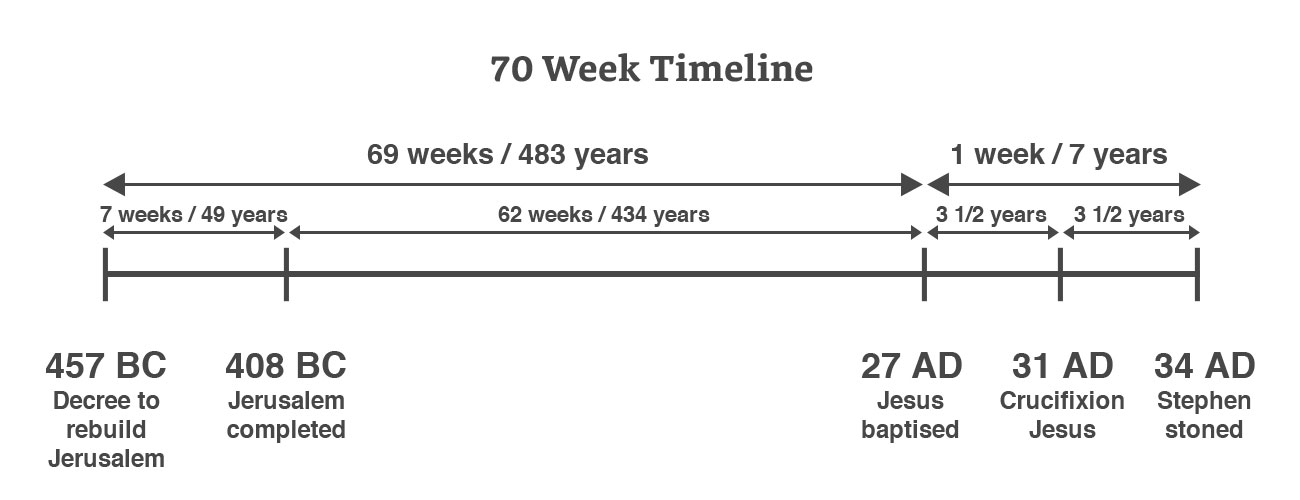
'seven weeks' = 49/yrs based on a week of years being 7/yrs (7 x 7 = 49)
'threescore and two weeks' = 434/yrs (62 x 7 = 434).
Combined we get a total of 483/yrs.
Messiah the Prince, Messiah means 'annointed' as does the word Christos (Christ) in Greek. The Hebrew word for prince is Nagiyd H5057 meaning; a commander. In Isaiah 55:4-5, we read, "Behold, I have given him for a witness to the people, a leader and commander to the people. Surely, you shall call a nation that you knew not, and nations that knew not you shall run to you because of the LORD your God, and for the Holy One of Israel; for he has glorified you." The word used in this verse for commander is also 'Nagiyd', and speaks to God foretelling the sending of His 'Annointed Commander,' Jesus Christ not just to the Jews but to the world.
Interesting: These two verses in Isaiah 55 apear to reveal a three way conversation taking place between God, Isaiah and Christ. In verse 4 God is speaking to Isaiah about Christ's coming, then in verse 5, God is speaking to Christ about His mission.
Daniel 9:26
And after threescore and two weeks shall Messiah be cut off, but not for himself: and the people of the prince that shall come shall destroy the city and the sanctuary; and the end thereof shall be with a flood, and unto the end of the war desolations are determined.
'And after threescore and two weeks' = 434/yrs (62 x 7 = 434).
'Messiah', Jesus Christ 'be cut off', The Hebrew word used for 'off' is H3772 karath; meaning to cut (off, down or asunder, to destroy, consume; specifically to covenant (make an alliance or bargain). This speaks to the rejection, betrayal and violent killing of Christ. It speaks to the prophecy in Isaiah 53:8 By oppression and judgment He was taken away, and who can recount His descendants? For He was cut off from the land of the living; He was stricken for the transgression of My people hence, ('but not for himself'). The covenant, alliance or bargain may speak to the nature by which Jesus was cut off, and destroyed. The Pharisees plotted with the Herodians to destroy him, and both Herod I and his son, Antipas sought to destroy Jesus then finally the High Priests cut a deal with Judas Iscariot (the son of perdition) promising him money to hand Jesus over by night when no one would see (rulers of darkness). This fit's the description of an alliance and a bargain made (for thirty pieces of silver), thus fulfilling the prophecy in Zechariah 11:13-14 And the LORD said unto me, Cast it unto the potter: a goodly price that I was priced at of them. And I took the thirty pieces of silver, and cast them to the potter in the house of the LORD. Then I cut asunder mine other staff, even Bands, that I might break the brotherhood between Judah and Israel. The Bigger picture in these verses point to the judgment of the branch of Judah being 'cut off' from the vine, that is, Jesus Christ and the spiritual Israel of God for rejecting Messiah.
'The people of the prince that shall come shall destroy the city and the sanctuary' This speaks to the Jewish revolts against the Roman occupation. After the Jews return to Jerusalem from captivity in Babylon the city, the street, wall and temple is rebuilt. After several generations the Hasmonean dynasty rises to power. The Hasmonean dynasty was a Jewish royal house that ruled Judea from the success of the Maccabean Revolt in c. 141 BCE until Rome's conquest of the region in 63 BCE. It was around 126 BC under this dynasty that several cities of Idumea become subdued by Hyrcanus who was not only king of Judea but also High Priest (the power of religion & politics in one man) a pope type figure. Hyrcanus permitted the Idumeans to remain in the land of their fathers on the conditions that they circumcised their genitals, converted to Judaism and submitted themselves under Jewish law. Here we learn of the Hasmonean Priest-kings forcing their customs, traditions and laws onto another people group which is no different to what the Babylonian priest-king Nebuchadnezzar did to Israel and the house of Judah. It is tyranny, and here we have Judah having not learnt from their punishment of captivity in Babylon now bullying the Idumeans. God the Father used Nebuchadnezzar to punish Judah to teach them a lesson. The lesson being what it feels like to be oppressed by a more powerful opponent and to serve as a warning to all nations who rebel against the power and authority of heaven. So from here we see Edom becoming Jews by religion integrating and disappearing into Jewry with many becoming Jewish leaders who were by blood Edomites.
We then see the rise of Rome in the region and in particular the rise of Herod I, an Idumean (Edomite) who under the authority of the Roman senate becomes king of Judah. Herod I by all accounts was another tyrannical king who oppressed the Jews and destroyed all who opposed him, marking a power shift from Judah to Edom over the region with Rome as the overseer. What motivated the cruelty of Herod? It is possible that Herod sought vengeance against the house of Judah and Israel for imposing Judaism, circumcision and Jewish laws on his Edomite ancestors and for taking their lands during the Hasmonean rule? The Herodian dynasty replaced the hereditary Levitical priesthood with whom they chose and there was great opression on the people with the burden of heavy taxes. For the every day Judean it must have seemed as though their way of life was being destroyed. It is not unthinkable to deduce that Rome would have known about the contentions between Judah and Edom which went back multi-generations to Esau and Jacob, and that Rome would have used this strategically to it's advantage to take control of the region when they empowered Herod the Edomite as king over Judah. It is the divide and conquer method, find your enemies common weaknesses, become the thin edge of the wedge by pitting one people group against another whilst Rome sits back acting as a kind of referee whilst their enemies destroy themselves.
Towards the end we get the rise of Simon Bar Giora who leads an army of rebels against the Roman occupation whose forces apparently end up fighting against each other as much as they did against the Romans. There was also John of Giscala, a Jewish Galilean who led an army of Zealots to revolt. According to the historian Josephus, John of Giscala ends up looting the temple and setting fire to it. Add into the mix a vast army of Idumean warriors who came up from the south joining forces with the Zealots which might have been a tactic to destroy Israel from within considering they slaughtered indiscriminately as we read in the account of Josephus in the Wars of the Jews. There were multiple factions rising with many men of war, some who sought glory for themselves, thinking justice could be achieved by the sword and with violence. God allows the lawless to destroy themselves, ultimately using the Romans to crush the revolts and to restore some kind of peace and sanity in the region when the city and the temple is destroyed in 70 AD. It's the story of the rise of the final beast kingdom (Rome), and the quest for earthly power and authority, nation shall rise against nation, kingdom against kingdom, men who reject the precepts of God, rejecting peace for violence resulting in God doing His mysterious work where all oppressive rulers, powers and authorities are put down allowing the Gospel message to prosper.
We can conclude from the scriptures and the historical record that it was the Jews ('the people') whom by their revolt against God the Father destroyed the city and the sanctuary. They brought destruction upon themselves. Jesus Christ is the ('prince that shall come'), the commander who was ultimately leading the front for peace but they rejected His precepts. When Jesus left the temple for the last time, having been rejected and knowing the rulers sought to kill Him, Jesus prophecied that not one stone of the temple would be left unturned. Jesus being the Alpha and Omega, knowing the beginning from the end.
Romeo Jewish historian Flavius Josephus wrote: "for I venture to affirm that the sedition destroyed the city, and the Romans destroyed the sedition, which it was a much harder thing to do than to destroy the walls; so that we may justly ascribe our misfortunes to our own people,"
Source: The Wars of the Jews, 5.248-5.290:257
In the biblical record, specifically John 19:11 Jesus said that it was those who had delivered Him over to Pilate who have the greater sin, and from that point forward Pilate sought to release Jesus but the Jewish High Priests began intimidating Pilate as a means to manipulate his decision. They accused Pilate in front of the crowds of being against Caesar for defending the innocence of Jesus. Who handed Jesus over to Pilate? It was Judas Iscariot, a man of Kerioth, a town in the tribe of Judah and one of the twelve disciples who handed Jesus over to the High Priests, Pharisees and the Elders of the Sanhedrin who in turn handed Jesus over to Herod who in turn handed Jesus over to Pilate. All the rulers of Judah sought the destruction of Jesus but prevailed nothing until Judas bargained with the High Priests, putting a price tag on Jesus, to hand Him over for thirty pieces of silver so that the scriptures might be fulfilled. Judas, being one of the twelve, and having insider knowledge of the garden where Jesus and his disciples would often go at night. It was Judas who led the armed servants of the High Priests to the garden where he would identify Jesus by betraying Him with a kiss.
'And the end thereof shall be with a flood, and unto the end of the war desolations are determined.' Again, speaking to the Jewish revolt that caused a flood of Jewish factions, Idumean warriors, and Roman soldiers to overwhelm the city with calamity as recorded in the war between the Jews and the Romans (66-70 AD).
Christ leaves a way of escape [Learn more] See also: Daniel 12:1.
Daniel 9:27
And he shall confirm the covenant with many for one week: and in the midst of the week he shall cause the sacrifice and the oblation to cease, and for the overspreading of abominations he shall make it desolate, even until the consummation, and that determined shall be poured upon the desolate.
'And he shall confirm the covenant with many for one week'. The word 'confirm' lets us know that the covenant must have existed prior to the seventieth week. The 'Everlasting Covenant' that God established with Abraham and his spiritual seed precedes the 'Mosaic Covenant' as written in Genesis 17:7: "And I will establish my covenant between me and thee and thy seed after thee in their generations for an everlasting covenant, to be a God unto thee, and to thy seed after thee." The spiritual Jews had a covenant relationship with the Father by faith. The fleshly Jews sought to earn salvation by obeying the Mosaic Covenant.
'one week' = 7/yrs based on a week of years being 7/yrs.
Jesus Christ confirmed the Everlasting Covenant with 'many' during his three and a half year ministry beginning with the twelve Apostles who were Jews waiting for Messiah. They believed by faith and were sent out first to the lost sheep of the house of Israel followed by the seventy who were sent out to the people of the nations. In the book of Acts we read that on the day of Pentecost three thousand Jews believed and more were added each day there after thus, many confirming the everlasting covenant with the Prince of Peace.
'And in the midst of the week he shall cause the sacrifice and the oblation to cease'.It was in the 'midst' (middle) of the seventieth week that Messiah was cut off. The sacrificial death of Messiah signified the end of the daily sacrificing of animals, with 'he', that is, Jesus Christ, being the Passover Lamb without spot that was the sacrifice to end all sacrifices. The 'oblation' (tribute) speaks to the donations that poured into the temple treasury 'ceased' when the temple was destroyed. The temple having become nothing more than a place of commerce to buy and sell animals for meaningless sacrifice.
'And for the overspreading of abominations he shall make it desolate'. The overspreading being the killing of Messiah Jesus Christ and the persecution of His followers after Christ was resurrected. The stoning of Stephen by the Sanhedrin would mark the end of probation for the rulers of the Jewish nation. The punishment being the people, the city and the temple made 'desolate' in 70 AD. It also speaks to the scattering of the power of the 'holy' people as revealed in Daniel 12:7.
'even until the consummation' speaks to the end of the ages as the Apostle Paul wrote in Hebrews 9:26 speaking of Jesus Christ: "But now He has appeared once for all at the end (the consummation) of the ages to do away with sin by the sacrifice of Himself." We are told how far back in time the ages go in Luke 11:51 where Jesus said, "from the blood of Abel to the blood of Zechariah, who was killed between the altar and the sanctuary. Yes, I tell you, all of it will be required of this generation." This verse confirms that Christ's one time sacrifice was for all sins.
'And that determined shall be poured upon the desolate', who are the desolate? In Luke 13:34-35 Jesus said, "O Jerusalem, Jerusalem, which killest the prophets, and stonest them that are sent unto thee; how often would I have gathered thy children together, as a hen doth gather her brood under her wings, and ye would not! Behold, your house is left unto you desolate: and verily I say unto you, Ye shall not see me, until the time come when ye shall say, Blessed is he that cometh in the name of the Lord." It is clear from these verses that the desolate are those who killed the prophets and Messiah that were sent to them by the Heavenly Father. Without Jesus Christ we can do nothing. The Jews were the guardians of the oracles of God, but they rejected His Son the promised Messiah. The Word of God was taken from them and given to a people who would worship God in spirit, who would keep His commandments and have the testimony (everlasting covenant) of Jesus Christ.
Where there is neither Greek nor Jew, circumcision nor uncircumcision, Barbarian, Scythian, bond nor free: but Christ is all, and in all. Colossians 3:11.
Summary
The verses of Daniel 9:24-27 all point to Christ's appearing, He is the Anointed One, Messiah the Prince appearing in the seventieth week to carry out His ministry. It points to the confirmation of His Everlasting Covenant with spiritual Israel where by faith in Jesus Christ all might be grafted in regardless of ethnicity or heritage. It points Christ's sacrifice with His blood as the Spotless Passover Lamb, which paid the price for our sins ending the need for temple animal sacrifice.
Note: At the beginning of the next chapter in Daniel 10:2 we read that Daniel was in mourning. Was this in response to the shocking revelation in chapter 9 regarding the rejection of the Messiah by Daniel's people, the fate of the city, temple, and his nation? The revelation in Daniel 9 would also serve as an explanation as to why Daniel chose not to return to Jerusalem with his people at the end of the captivity in Babylon.
Seventy Week Timeline
For a comprehensive breakdown of the 490/yr timeline of this prophecy see also the studies of David Wilcoxson (link below).
Related:
Understanding the 490/yr Timeline
Complete breakdown By David Wilcoxson (YouTube video presentation Part 1 of 3)