Revelation of Jesus Christ
From the KJV 1611 with Strong's Concordance
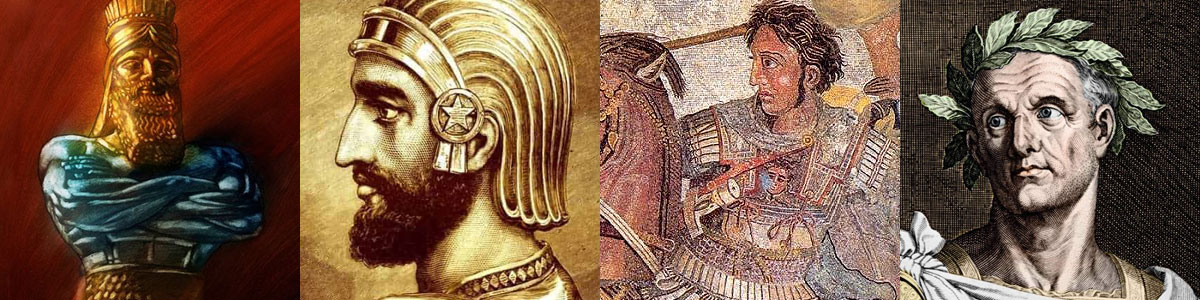
The Four Beasts of Daniel 7 - Part 3
The Third Beast
(The Grecian Empire)
Daniel 7:6
After this I beheld, and lo another, like a leopard, which had upon the back of it four wings of a fowl; the beast had also four heads; and dominion was given to it.
The 'leopard' represents the beast empire of Greece and specifically Alexander the Great who conquered the known world swiftly like a leopard. His military prowess exceeding the previous beast empires, that said, Alexander died in his early thirties in Babylon. The 'four wings of a fowl' possibly pointing to the four winds, four corners or four quarters of the known earth as his direction for conquest and dominion. The 'four heads' speaks to Alexander's four generals whom upon Alexander's death go forth dividing up his empire into four main Hellenistic kingdoms, dominions (empires). See also: Daniel 11:4
331 BC - Alexander the Great, the Macedonian king finally brought the Persian monarch to bay at the Battle of Guagamela.
Beliefs of divinity: Alexander the Great's mother, Olympias, believed and taught him that he was not the son of King Philip II, but of the god Zeus. She told him he was conceived when a thunderbolt 'the symbol of Zeus' entered her womb, and this belief significantly influenced Alexander's own view of his divine parentage. At the Siwa Oasis oracle, Alexander was confirmed by a priest as the son of Ammon-Zeus, which reinforced the beliefs instilled in him by his mother.
History: Alexander was 32 when he died in 323 BC in the palace of Nebuchadnezzar II in Babylon. During his 13 year reign as the king of Macedonia, Alexander created one of the largest empires of the ancient world, stretching from Greece to northwestern India. The Diadochi were the four most prominent generals of Alexander the Great, who divided his empire into Hellenistic kingdoms after his death. These were Ptolemy I who founded the Ptolemaic Kingdom of Egypt, Cassander took control of Macedonia and Greece (Macedon Kingdom), Seleucus I Nicator established the Selecid Empire in the Near East, and Antigonus I held much of Asia Minor (The Kingdom of Pergamon) before being defeated and killed by combined forces of Cassander, Ptolemy, and Seleucus at the battle of Ipsus in 301 BC.
Was Alexander a priest-king? Yes, Alexander the Great could be described as a "priest king" because he adopted religious titles and roles, including being crowned Pharaoh in Egypt and being hailed as the son of gods, reflecting a fusion of political power and religious authority. He accepted these divine connections to legitimise his rule, particularly after conquering Egypt, where he was recognized as a divine ruler. Source: Google Ai
Titles: Alexander was a collector of titles, and besides the epithet 'the Great' he also became King of Macedon, Hegemon of the Hellenic League, Shahanshan (king of kings) of Persia, Pharaoh of Egypt, and Lord of Asia. He also received divine titles such as the Son of Ra in Egypt, which might be translated as both "son of Zeus" (because Ra was Egypt's supreme god) and "son of Helios" (because Ra was a solar deity). After visiting the oracle of Siwa, he was convinced he was the son of Zeus-Ammon. The most prevalent was aniketos, that is, invincible which he received from a priestess in Delphi. He was considered a god by some in his later life.
The Builder: Alexander the Great built many structures, including over 20 cities, many named after himself, the most famous being Alexandria in Egypt which became a major center of commerce and learning in the ancient world. These settlements helped spread Greek culture, language, and civilization throughout the regions he conquered, leading to a new "Hellenistic" era. During his campaign against the Persians, he had his engineers construct a massive land bridge, or causeway, across the water to reach the island city of Tyre. Some sources suggest he also built defence works in other areas, such as the "Wall of Alexander" in Margiana. A temple was built in Egypt during his lifetime, dedicated to the gods Amun and Horus. Ruins of other public buildings, houses, and religious sites are associated with his time, such as at Perperikon and Luxor Temple.
Grecia in prophecy: Alexander is also represented as the 'Notable Horn between the eyes of the He Goat' in the Daniel 8:5 prophecy with the Ram with two horns, one horn being Media, and the higher horn being Persia which also corresponds with the Bear being raised up on one side in Daniel 7:5. Alexander is also the 'mighty king' noted in the Daniel 11:2-4 prophecy.
Bigger Picture: the Chaldean word 'leopard' H5245 'n@mar' corresponds to H5246 'namer' meaning to filtrate, that is, be limpid. The method of filtering to make a clear water, thus speaking to God the Father's intent, and the revelation of the method to create the sea of Crystal glass that is about the throne in heaven as written in Revelation, that is, a transparent sea of people who have no secrets, having confessed, humbled, and repented, that is, submitted their souls to the power and authority of heaven resulting in peace, and harmony with the Father. Jesus used parables and metaphors as examples such as the 'parable of the tares', 'gold tried in the fire to remove the dross', and a 'net that is cast into the sea, catching all the fish and the angels sorting through the fish, keeping the good ones and throwing away the bad ones'. It all points to filtration. If we choose to accept that this process needs to be done given that we are all born into sin with the desires of the flesh, and rather than fighting against the Most High and His will, we are indeed submitting to God's power and authority which will ultimately lead to peace within. His will be done on earth as it is in heaven! The enemy inverts this by infiltration, he sows tares among the wheat, that is, lies, deceptions, and falsehoods hence, God's need to filtrate.