Revelation of Jesus Christ
From the KJV 1611 with Strong's Concordance
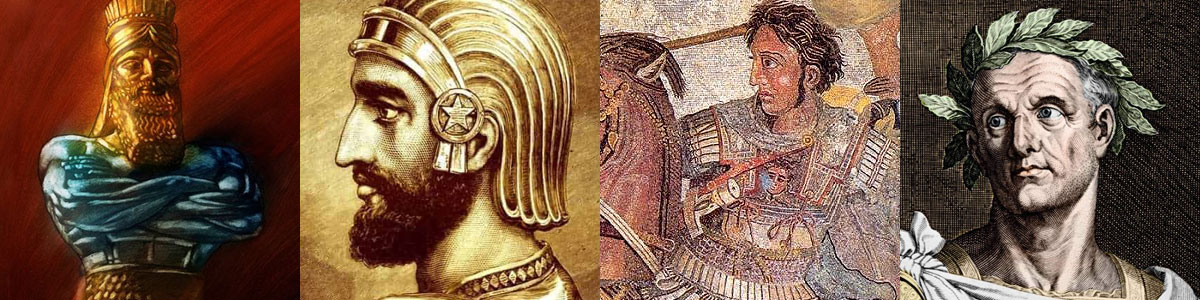
The Four Beasts of Daniel 7 - Part 2
The Second Beast
(Medo - Persian Empire)
Daniel 7:5
And behold another beast, a second, like to a bear, and it raised up itself on one side, and it had three ribs in the mouth of it between the teeth of it: and they said thus unto it, Arise, devour much flesh.
The 'bear' represents the Medes and Persians who co-ruled over Babylon taking control after Belshazzar & Nabonidus, the last kings of the Chaldean empire had fallen. The Medes ruled over Babylon first under king Darius followed by Cyrus the king of the Persian empire which was the greater of the two empires in size, hence the bear being raised up on one side. The 'three ribs in the mouth' H6763 tsela' is the same word used for the rib taken from Adam to make the woman, and may be alluding to the oracles of the age (temple priestesses, prophetesses, divination, delphi) whom the kings of the earth sought counsel before going to war. These oracles by means of divination speak from the mouth between the teeth of the bear 'and they said this to the beast, Arise, devour much flesh,' that is, go into battle and destroy.
See: Genesis 2:21-22 And the LORD God caused a deep sleep to fall upon Adam, and he slept; and he took one of his ribs... It is also worth noting that God the Father can use the mouths of the oracles to achieve His desired outcome.
539 BC - The Neo-Babylonian Empire was conquered by Cyrus and the Achaemenid Persian Empire marking the collapse of the Chaldean dynasty.
Was Cyrus the Great a priest-king? No, Cyrus the Great was not a "priest-king" in the sense of being a religious ruler with both political and priestly authority over a foreign religion; rather, he was a king who was a pious Zoroastrian himself and also showed respect for the religions of the diverse peoples within his empire. He was known for his tolerance and permitted the conquered peoples, such as the Jews, to practice their own faiths and rebuild their temples, which helped him gain their loyalty. Source: Google Ai
The Builder: Cyrus was a builder, not only a founder of the Achaemenid Empire but also a significant physical builder. He commissioned the construction of his capital city, Pasargadae, and ordered the rebuilding of temples and cities, such as the Second Temple in Jerusalem, making him a "builder" in both the imperial and physical sense. Cyrus also had inscriptions made that referred to him as a "rebuilder of Esagila and Ezida," which were important temples in Babylon. He was also associated with the development of the Royal Road, a major infrastructure project that connected the vast Persian Empire.
Titles of Cyrus included King of Persia: This reflects his rule over the Achaemenid Empire. King of Babylon: This title was proclaimed after he conquered Babylon and presented himself as the successor to its kings. King of the Four Corners of the World: This title emphasizes the vast, global scope of his empire. King of Sumer and Akkad: This title is a legacy from the ancient rulers of Mesopotamia. King of Kings (Shahanshah): This title, originally from the Assyrians, signifies his supreme authority over other rulers and kingdoms, and it is the origin of the modern "shah of Iran". King of Anshan: This title connects him to his Achaemenid dynasty's origins in the region of Anshan. Cyrus the Elder was an alternative name, especially when distinguished from other King Cyri of Achaemenid dynasty, such as Cyrus the Younger. Kourosh was the Persian name from which "Cyrus" is derived, meaning "Lord of the sun".
Was Darius the Great a priest-king? No, Darius was not a priest king, though he was a religious leader who supported native religious institutions and believed in the Zoroastrian deity Ahura Mazda. The rulers of the Achaemenid Empire, including Darius I, were kings, not priests, but they often acted in the interest of the gods and supported various cults to maintain political stability and gain support from conquered peoples. Source: Google Ai
The Builder: Darius founded the new capital city of Persepolis, building a vast palace complex that included fortifications, an audience hall (apadana), and a treasury. He made Susa the administrative capital and restored its fortifications, constructing a new palace and audience hall (apadana). He built the impressive "Royal Road" stretching over 1,500 miles from Susa to the Aegean Sea, complete with stations for relaying messages. He also undertook other construction projects throughout the empire, including at Babylon, Ecbatana, and in Egypt, where he built a canal connecting the Nile River to the Red Sea.
Titles of Darius included "Great King, King of Kings, King of Persia, King of the Countries, the son of Hystaspes, the grandson of Arsames, the Achaemenid". He was commonly known as Darius the Great, King of Persia, and Great King. Title of authority included "King of Kings" reflected his position as the supreme ruler of the many subject kings and peoples within the empire.
Medo-Persian Law - "Now, O king, establish the decree, and sign the writing, that it be not changed, according to the law of the Medes and Persians, which altereth not." (Daniel 6:8). The unrighteousness of the Medo-Persian law was that once a decree was made it could not be changed by the king or any future king, no matter how unjust - Darius was deceived by the presidents and princes into signing a decree that would ensure Daniel is cast into the lion's den. These wicked men who were counsel to Darius the king conspired to obtain an idolatrous decree to entrap and destroy Daniel who was innocent. Therefore, the Medo-Persian law was seriously flawed.
Note: The Roman Catholic Church creates 'Cannon Laws' that once signed by a pope they cannot be changed by the pope or any future pope.