Revelation of Jesus Christ
From the KJV 1611 with Strong's Concordance
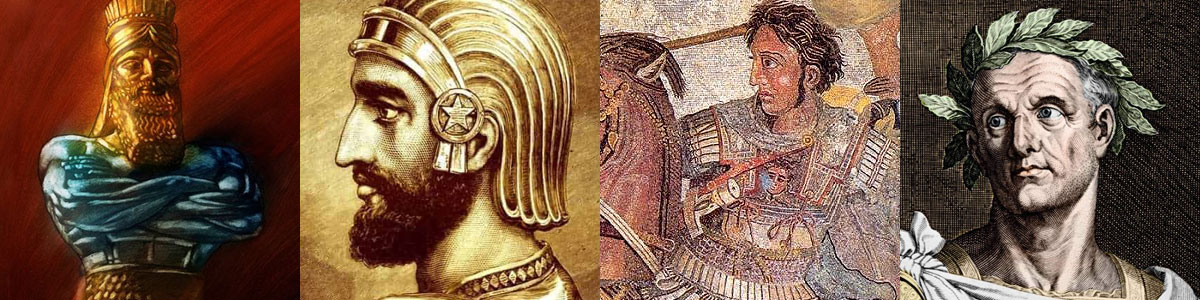
The Four Beasts of Daniel 7 - Part 1
In the Daniel 2 vision of Nebuchadnezzar's dream we saw how it points to idolatry, and how each section of the idolatrous figure represents four kingdoms in succession and how each becomes inferior to the previous using metals as the metaphor beginning with the head of gold (Chaldean's Babylon), the chest and arms of silver (Medo-Persia), belly and thighs of bronze (Grecia), legs of iron (Rome), the feet of iron and ten toes mixed with potters clay, miry clay and mud, and then finally a stone cut out without hands smashes the whole idolatrous figure to pieces where it is turned to dust then blown away on the wind. Pointing to the end of all man-made religions and the assumption of earthly power and authority.
The vision in Daniel 7 depicts four beasts (therion; a dangerous animal) representing empire and dominion. Here I hope to unravel some of the important details to the prophecy so the reader can understand the nature and the driving forces behind the four beast empires. We'll unpack the ten horns and the little horn that rises out of the fourth beast empire. It is important to note that these beast kingdoms rise up out of times of great apostasy on the earth.
The Vision's Components:
- The Four Winds & The Great Sea
- The First Beast (Babylon)
- The Second Beast (Medo-Persia)
- The Third Beast (Grecia)
- The Fourth Beast (Rome)
- The Ten Horns
- The Little Horn Power
The Four Winds & The Great Sea
(Revolt / Apostasy)
Daniel 7:2
Daniel spake and said, I saw in my vision by night, and, behold, the four winds of the heaven strove upon the great sea.
The vision that Daniel had was 'by night' (darkness, adversity). The 'four winds' are four spirits; H7308 ruwach (spirit, mind) from H7307 (mind, life, anger, unsubstantiality). The spirits are 'of heaven'; H8064 (alluding to the visible arch, the higher ether where the celestial bodies revolve). They 'strove'; that is, (to rush forth, gush as water, to issue) 'upon the great' (chief, master, captain) 'sea'; from H3220 (to roar, a sea, noisy surf). Speaking to four spirits from the heavens that are dispatched, rushing forth like a flood upon a great sea of raging peoples, nations and tongues. It speaks to times of calamity, revolt, war, lawlessness, great apostasy, a falling away from God's precepts from which these beasts arise.
Revolt/Apostasy: To disclaim allegiance and subjection to God; to reject the power and authority of the King of kings. Isaiah 31:6.
'Let no man deceive you by any means: for that day shall not come, except there come a falling away first, and that man of sin be revealed, the son of perdition;' Thessalonians 2:3.
Daniel 7:3
And four great beasts came up from the sea, diverse one from another.
The 'four great beasts' are four kings (kingdoms). They ascend out of the sea of people. Each beast kingdom is diverse (altered, changed from one another).
The First Beast
(Babylon - The Chaldean Empire)
Daniel 7:4
The first was like a lion, and had eagle's wings: I beheld till the wings thereof were plucked, and it was lifted up from the earth, and made stand upon the feet as a man, and a man's heart was given to it.
The 'lion' speaks to violence and represents the kingdom of Babylon who had the monopoly on violence in the region. The eagle represents 'to lacerate', and the ability to snatch away. The 'eagle's wings' (to arch the back, the body or self) speaking to pride, power and self confidence, a trait in man that was to be plucked, and points to the Assyrian empire who reigned over Babylon before Nebuchadnezzar's Chaldean empire gained control.
These kings of Babylon attributed their success to themselves and gave no thanks or glory to God the Father. The Babylonian empire sought to expand it's dominion through war and violence both under Assyrian dominance and Chaldean. 'It was lifted up from the earth, and made to stand upon the feet as a man, and a man's heart was given to it' could be speaking directly to Nebuchadnezzar who was the head of gold and a king of kings (feudalism), someone whom future tyrannical leaders would aspire to (an idolatrous figure), though ultimately punished by God and given the heart of a beast and made to eat the grass of the field like an ox for seven years. He is then made upright and given a man's heart, and his senses are returned to him where he acknowledges the Father in heaven as the supreme power and authority.
The bigger picture: God gave all power and authority to Nebuchadnezzar to pluck Judah away and also destroy many of the nations (as prophesied in Jeremiah) and then God plucks the power from the Babylonian king when he had served God's purpose. This major event would send a powerful message to all future leaders moving forward. It also displays the long suffering, forgiving and merciful character of the heavenly Father that if we confess with our mouths and repent, He will take us back and show us a better way.
612 BC - Babylonia led an alliance in an attack in 612 BC against the Assyrian capital, Nineveh, also known as the fall of Nineveh.
Was Nebuchadnezzar a priest-king? Yes, Nebuchadnezzar served as the high priest of the Eanna temple and was deeply involved in religious and building projects, but he was primarily known as a warrior-king and rebuilder of cities rather than a "priest-king" in the modern sense of someone who held both religious and political power (church and state in one man). His reign emphasized piety and devotion to his gods through construction, but his main historical role was as a military leader and builder of the Neo-Babylonian Empire. Source: Google Ai
The Builder: Nebuchadnezzar II was a famous and prolific builder, known for transforming and beautifying the city of Babylon with grand construction projects. Major building projects include the Ishtar Gate, a monumental and colourful gate that was the entrance to the inner city of Babylon. Processional Way was the street leading from the Ishtar Gate, decorated with the images of lions. The Hanging Gardens of Babylon was one of the most famous projects credited to him, said to have been built for his wife. He renovated major religious structures like the Esagila (temple of Marduk) and Etemenanki (a ziggurat, sometimes called the Tower of Babel). He significantly enlarged the city's walls to make them more formidable. He brought back considerable resources from his military campaigns to fund these massive projects, with prisoners of war and craftsmen, including those from Judah, being used for the labour. His construction projects were a way to solidify and glorify his empire, demonstrating its power and sophistication.
Titles: Nebuchadnezzar's titles included King of Babylon: The primary title for his rule over the Neo-Babylonian Empire. King of Sumer and Akkad: A traditional title used for rulers of southern Mesopotamia. King of the Universe: A grander title reflecting the empire's extensive reach. Pious prince/Exalted ruler: Titles emphasizing his devotion to the gods, particularly Marduk. Beloved of the god Marduk: This designation highlights his close relationship with the chief god of Babylon. Foremost heir of Nabopolassar: A title used to denote his lineage and his right to the throne as the son of Nabopolassar.
The origins of Babylon go back to Nimrod, the mighty (warrior) hunter who sought to make men dependent of him and his government rather than attributing their prosperity to God. Nimrod's main weapons of choice was fear, idolatry and the control of resources, a theme that ripples through all the beast kingdoms to this day. Nimrod was a son of Cush, who was a son of Ham, who was a son of Noah. Nimrod built many cities including Babel and it's Tower in the plain of Shinar which is in modern day Iraq. The biblical account in Genesis 10 states that Nimrod's kingdom included Babel, Uruk, and Akkad, and later traditions attribute the building of cities like Nineveh and Calah (modern Nimrud) to him. He is often portrayed as the first empire-builder, who used his power to unite people under his rule and construct cities. Nimrod's building projects, particularly the Tower of Babel, are often seen as symbols of human pride and rebellion against God.
Obsession with Time: According to A. Hislop in the Two Babylons, Kronos (time) was the first king of Babylon, that is, Nimrod. There is strong evidence that the ancient kings had an obsession with time, calendars and the Zodiac. In chapter 3 of the book of Daniel we see Nebuchadnezzar erect a golden image in the plain of Dura which all were to bow down to and worship at a random time when a musical instrument was sounded. Daniel, after a vision blesses God and says "He changes the times and seasons" not man. There have been contentions over whose calendar is correct since the beginning, as if to suggest that men can decide times and seasons when in reality, man has no real control over the things that God created but rather men try to give the illusion they are in control. It points to the ability to micro manage everyones lives in a "Simon says" way. It is probable that from such early stories we get phrases such as "He who pays the piper calls the tune", that is, the person with the financial power has the authority to tell everyone what to do.
Related: The great image in Nebuchadnezzar's dream
Related: The Priesthood of Babylon & the Cult of Inanna