Revelation of Jesus Christ
From the KJV 1611 with Strong's Concordance
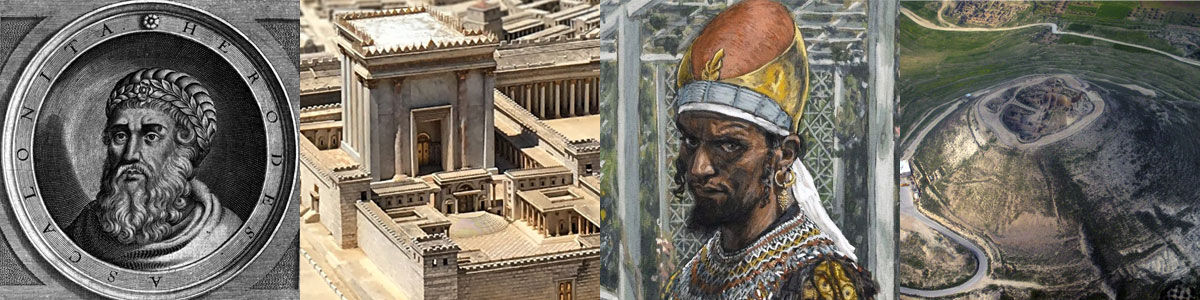
The Herodian Mind
Herod the Great (73/74 BCE - 4 BCE)
He has been described as "a madman who murdered his own family and a great many rabbis", [9] "the evil genius of the Judean nation", [10] "prepared to commit any crime in order to gratify his unbounded ambition" [11] and "the greatest builder in Jewish history". [9] He is known for his colossal building projects throughout Judea, including his expansion of the Second Temple in Jerusalem (Herod's Temple), the construction of the port of Cesarea Maritima, the fortress at Masada and Herodium. Vital details of his life are recorded in the works of the 1st century CE Roman-Jewish historian Josephus.
9.^a b Spino, Ken (Rabbi) (2010). "History Crash Course #31: Herod the Great (online)". Crash Course in Jewish History. Targum Press. ISBN 978-1-5687-1532-2. Retrieved 7 May 2013.
10.^ Tierney, John. "Herod: Herod the Great", Catholic Encyclopedia (1910): "Herod, surnamed the Great, called by Gratz "the evil genius of the Judean nation" (Hist., v. II, p77).
11.^ Herod I at Jewish Encyclopedia: "above all, he was prepared to commit any crime in order to gratify his unbounded ambition"
The Herodian Dynasty was a Judean dynasty of Idumaean/Edomite descent. Herodian dynasty began with Herod the Great, who assumed the throne of Judea, with Roman support, bringing down the century long Hasmonean Kingdom. His kingdom lasted until his death in 4 BCE, when it was divided between his sons as Tetrarchy, which lasted for about 10 years. Most of those kingdoms, including Judea proper, were incorporated into Judaea Province in 6 CE, though limited Herodian kingship continued in Northern Levant until 92, when the last Herodian monarch, Agrippa II, died and Rome assumed full power of his domain. These "Judaised" Edomites were not considered Jewish by the dominant Pharisaic tradition, so even though Herod may have considered himself of the Jewish faith, he was not considered Jewish by the observant and nationalist Jews of Judea. [15] A loyal supporter of Hyrcanus II, Antipater appointed Herod governor of Galilee at 25, and his elder brother, Phasael, governor of Jerusalem. He enjoyed backing of Rome but his brutality was condemned by the Sanhedrin. [16] Two years later Antigonus, Hyrcanus' nephew, took the throne from his uncle with the help of the Parthians. Herod fled to Rome to plead with the Romans to restore him to power. There he was elected "King of the Jews" by the Roman Senate. [17]
15.^ Josephus. Antiquities of the Jews, 14.15.2.16.^ Herod I at Jewish Encyclopedia:
17.^ Josephus. The Wars of the Jews
As it is written, Jacob have I loved, but Esau have I hated. Romans 9:13.
His first leadership role was as governor of the Galilee, a position granted to him by his father, Antipater. Early on, Herod demonstrates his brutality by ruthlessly crushing a revolt in the Galilee. Later, during the Parthian incursion in 40 BC, he flees Jerusalem and makes his way to Rome, where he impresses Mark Anthony and, with his help, persuades the Roman senate to name him "King of the Jews," so he can return and bring Judea back under Roman control. And, after three years of fighting, Herod indeed takes the throne as King of Judea.
Note: it was after this that the Magi (wise men) arrive at Jerusalem with news of another "King of the Jews" who was to be born, that being Jesus Christ. Herod then demands from the high priests and scribes to search the prophecies of the prophets to learn where the child is to be born. Having acquired the location, he orders the slaughter of all children from two years old and under in Bethlehem. (See Matthew 2). What was the motivation of Herod to rule over the Judeans (Jews)? He went to great lengths to become king over Judea and was prepared to do anything, even the slaughter of children to maintain his title. He was not a descendant of one of the tribes of Israel who were the sons of Jacob. Herod was an Edomite, a descendant of Jacob's brother Esau. Esau traded his birthright to his brother Jacob for a bowl of food. Could it be that the descendants of Esau sought to reclaim the birthright which would have included the promised land?
Herod's Temple
Herod saw fit, however, to place at the main entrance a huge Roman eagle, which pious Jews saw as sacrilege. Two teachers and a group of Torah students smashed the emblem of idolatry and oppression, but Herod had them hunted down and dragged in chains to his residence in Jericho, where they were burned alive. Thus, having built the Temple, Herod took pains to make sure it would be run without future problems of this kind. He appointed his own High Priest, having by then put to death forty-six leading members of the Sanhedrin, the rabbinical court.
http://www.ldmark.com/Hebrews.htm
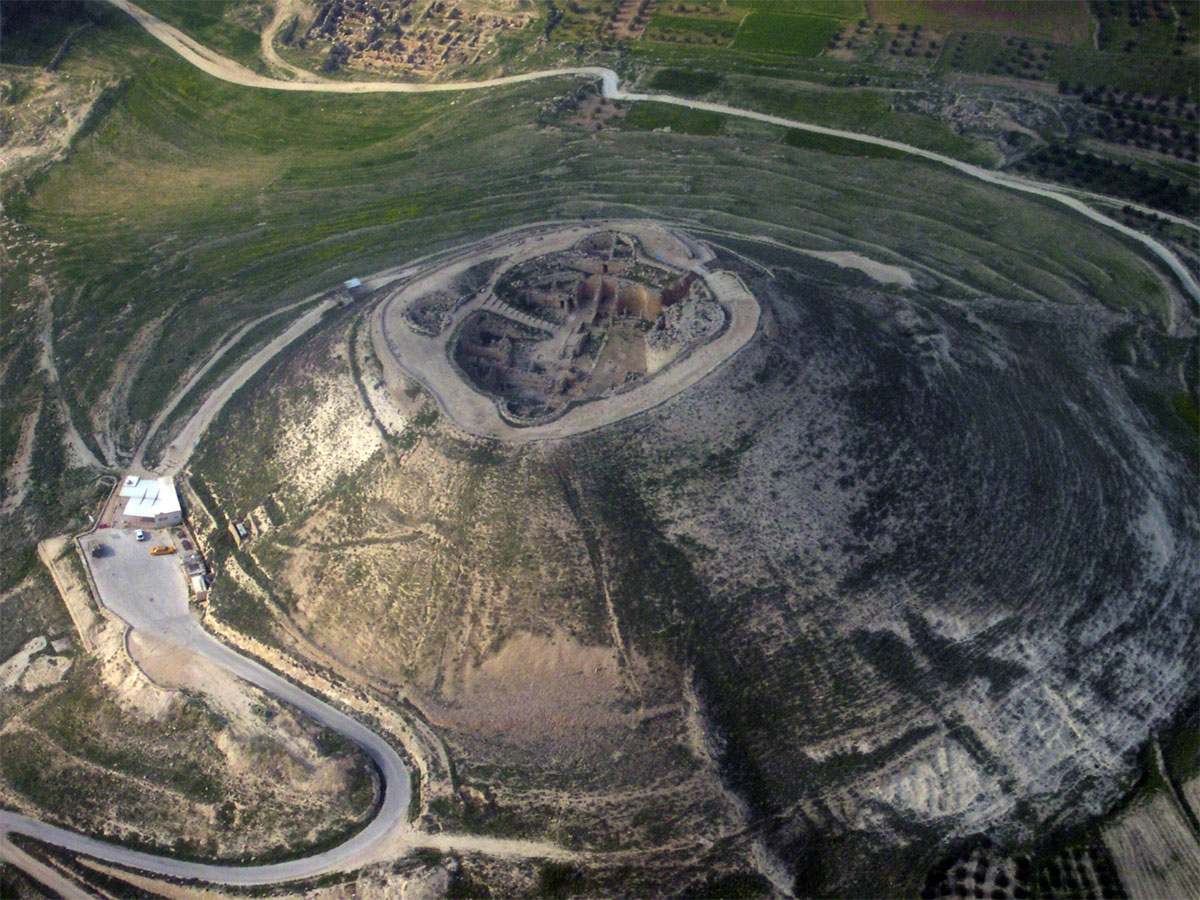 Foxes have holes - The Herodium fortress of Herod
Rulers of darkness
Herod's cruelty was legendary. Among the many he had murdered included his brother-in-law, his wife, two of his sons, his mother-in-law, another brother-in-law and many others. He established an enormous secret police force, brutally killed anyone suspected of plotting against him, and created Roman peace by slaughtering all dissidents. ...
http://www.ldmark.com/Hebrews.htm
Herod Antipas (born before 20 BC - died after 39 AD) married his brother's wife Herodeas, John the Baptist called this out as being unlawful. Herod had John imprisoned, and upon an oath Herodeas, the wife of Herod takes advantage and requests the head of John. See: Oaths, and allegiances.
Both Herod's had the mindset of Cain.
It was the High Priests who condemned Jesus guilty, and to be put to death. With Herod installing his own priesthood in his Temple it is not a stretch to suggest that the order to destroy Jesus may have come directly from Herod.
On that very day some Pharisees came, saying to Him, “Get out and depart from here, for Herod wants to kill You.” Luke 13:31.
Herod and Pilate become friends
Herod and the Roman Governor Pilate become friends when Christ is crucified.
And the same day Pilate and Herod were made friends together: for before they were at enmity between themselves. Luke 23:12.
The Judean priests align to Rome
And it was the preparation of the passover, and about the sixth hour: and he (Pilate) said to the Jews, Behold your King! But they cried out, Away with him, away with him, crucify him. Pilate said to them, Shall I crucify your King? The chief priests answered, We have no king but Caesar. John 19:14-15.
Revelation
And there appeared another wonder in heaven, and behold a great red dragon, having seven heads, and ten horns, and seven crowns upon his heads. Rev 12:3.
And his tail drew the third part of the stars of heaven, and did cast them to the earth: And the dragon stood before the woman which was ready to be delivered, for to devour her child as soon as it was born. Rev 12:4.
And she brought forth a man child, who was to rule all nations with a rod of iron: and her child was caught up unto God, and his Throne. Rev 12:5.
The final acts of Herod Agrippa I
Now about that time Herod the king stretched forth his hands to vex certain of the church. And he killed James the brother of John with the sword. And because he saw it pleased the Jews, he proceeded further to take Peter also. Acts 12:1-2.
And when Peter was come to himself, he said, Now I know of a surety, that the Lord hath sent his angel, and hath delivered me out of the hand of Herod, and from all the expectation of the people of the Jews. Acts 12:11.
And upon a set day Herod, arrayed in royal apparel, sat upon his throne, and made an oration unto them. And the people gave a shout, saying, It is the voice of a god, and not of a man. And immediately the angel of the Lord smote him, because he gave not God the glory: and he was eaten of worms, and gave up the ghost. But the word of God grew and multiplied. Acts 21:24.
Motivations for evil?
The Herodian dynasty were of Idumean (Edomite) ancestry. The Edomites are ancestors of Esau, who was the brother of Jacob, who is the patriarch of the tribes of Israel. Esau and Jacob were twins with Esau born first. Esau sold his birthright to Jacob for a bowl of food and then later Jacob usurps Esau's blessing from their father Isaac by pretending to be Esau. These exploits of Jacob would across the generations create contentions between the ancestors of Esau and the ancestors of Jacob. When we arrive at the Hasmonean dynasty of Judah namely the priest-king Hyrcanus we learn of this ruler taking the lands of the Idumeans who were Edomites. Hyrcanus allows them to remain in the land of their fathers on the condition they are circumcised, convert to Judaism and keep Jewish laws.
Iron mixed with miry clay?
This conversion allowed Edomites to become Jews by religion and many Idumeans migrated and integrated into the region of Judea. Several generation pass and we get the rise of Rome in the region paving the way for Herod I, an Edomite by ancestry considered Jewish becomes a vassal king of Judea under Rome's authority. Is it possible that Herod sought revenge against the Hasmonean royal house of Judah for subduing the land of his ancestors and forcing them to convert to Judaism?
The oppressive reign of the Hasmoneans would come back to bite them when the tables are turned on Israel and the house of Judah under the oppressive Herodian rule. Finally in 70 AD the temple and city of Jerusalem are destroyed in a bloody revolt fuelled by Jews and Idumeans with Rome being the tool of God to crush both of these oppressive regimes. Rome being the least oppressive of the three, in the sense that it was not imposing it's religious ideology, customs, traditions and laws onto others. That would happen later, particularly under the Roman Catholic Church.
It is not unthinkable to deduce that Rome would have known about the contentions between Judah and Edom which went back multi-generations to Esau and Jacob, and that Rome would have capitalised on this detail to it's advantage to take control of the region when they empowered Herod the Edomite as king over Judah. It is the divide and conquer method, find your enemies common weaknesses, become the thin edge of the wedge by pitting one people group against another whilst Rome sits back acting as a kind of referee whilst their enemies destroy themselves. See: The Seventy Weeks of Daniel 9.
Bigger picture
The prophecies of Daniel's visions of the idolatrous image, and the four beasts beginning with the lion that represented Nebuchadnezzar (the head of gold), his mind set, his tryanny and his kingdom of Babylon, a symbol of fuedalism and empire adopted from Nimrod the first of the post flood monarchs. Nebuchadnezzar was a king of kings ruling over a feudal (beast) system that is given over to Medo Persian rule, then to Grecian rule, and ends with Rome taking the titles, and earthly fuedal power. Herod received his earthly power, authority, and title as the king of Judea from the Roman senate thus making him a vassal king of the Roman Empire.
And in the days of these kings shall the God of heaven set up a kingdom, which shall never be destroyed: and the kingdom shall not be left to other people, but it shall break in pieces and consume all these kingdoms, and it shall stand for ever. Daniel 2:44.
The hidden hand of God was at work, and by crucifying Jesus they not only fulfilled the prophetic Word of God, they sealed the fate of the satanic kingdom. Christ's ascension to the Father saw all heavenly powers and authorities being made subject to him. With balance and harmony restored in the heavenly realm, the acuser of the brethren is cast down, and the earthly powers, and authorities that rise up against Christ both past and future are put down.
Jesus said to them, “Have you never read in the Scriptures: ‘The stone which the builders rejected Has become the chief cornerstone. This was the LORD’s doing, And it is marvelous in our eyes’? Matthew 21:42.
Is Daniel 11 the prophecy of the Herodian rise to power and the first Emperor? Compare with the historical view visit worldhistory.org/Herod_the_Great/